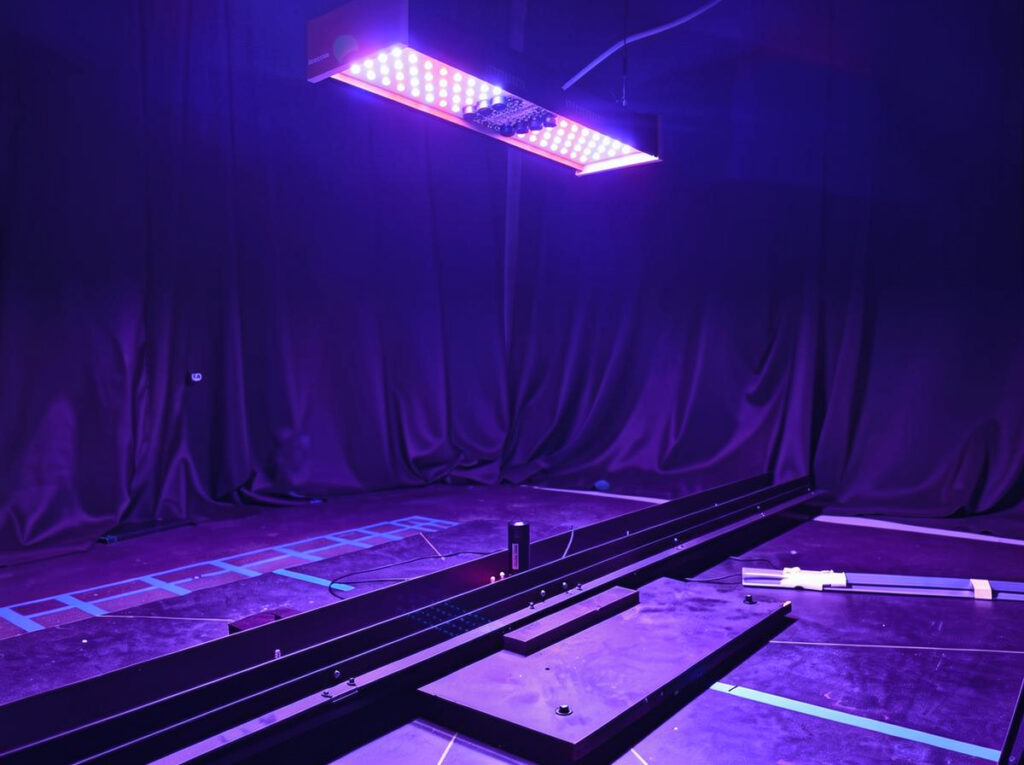
Agile Spectrum luminaries are built to deliver lighting precision that matches strict academic protocols. Our technology directly supports breakthrough research in plant genetics, metabolic pathways, and photobiology efficiency.
Exploring Beyond the Standard PAR Spectrum
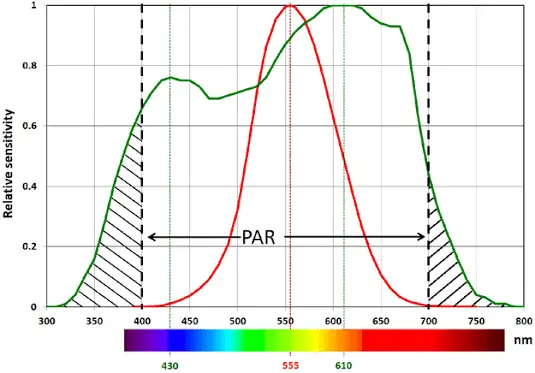
The ASGL is designed to provide illumination beyond the standard PAR spectrum due to emerging research that has shown wavelengths beyond this range, particularly far-red light, also influence photosynthesis, plant morphology, and developmental responses. This variability, versatility and spectral range allows researchers and growers to determine and provide the most efficient light program/recipe which will reduce energy costs while maintaining optimal growth conditions for their plants.
Accelerating Plant Genetic Engineering & Plastid Transformation
(Rutgers University) Our programmable arrays have been successfully deployed in advanced university trials to expedite the growth cycles of Arabidopsis thaliana during critical plastid transformation and Agrobacterium genomic testing. When initial light intensity proves too stressful for fragile transgenic specimens, the system’s digital attenuators allow researchers to effortlessly lower the active recipes down to the exact intensity necessary, through a secure network.
Intermittent Illumination & Kinetic Photosynthetic Saturation
Agile Spectrum fixtures support pulse width modulation (PWM), while maintaining the ability to adjust their intensities, enabling researchers to investigate plant responses to combined intermittent and various intensity illumination. These experiments help characterize photosynthetic efficiency, electron transport behavior, and non-photochemical quenching while exploring how rapidly changing light conditions affect plant performance.
Isolating Photomorphogenic Pathways & Secondary Metabolites
With 8 completely independant spectral channels, the ASGL system allows researchers to isolate narrow-band wavelengths to study specific photoreceptor behaviors (such as phytochromes, cryptochromes, and phototropins). Laboratories can manipulate discrete ratios—such as UV-A stress signaling or custom far-red fractions—to induce targeted secondary metabolite accumulation, alter volatile organic compound profiles, and map precise photomorphogenic triggers without changing overall photosynthetic photon flux density (PPFD).
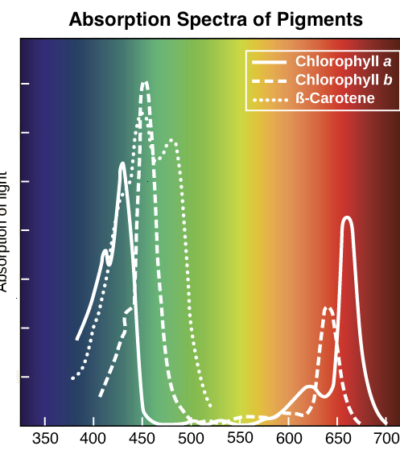
This line graph illustrates the light absorption spectra of three plant pigments across the visible spectrum (350 to 700 nanometers).